
Tree-based solutions in the refugee-hosting landscapes of Northwestern Uganda 2017 to 2025: A case study and guidance
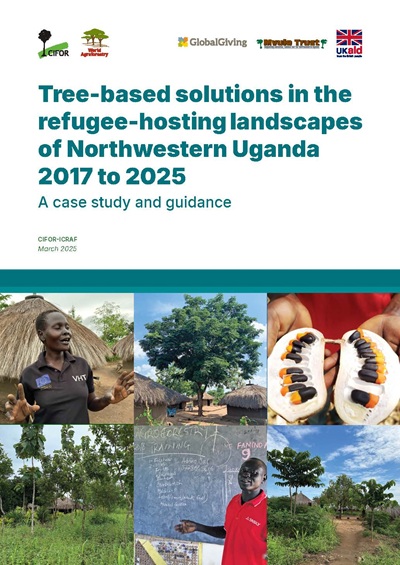
This is a report about a project that began in 2017, when many were sceptical that refugees could or would grow trees. Their arguments included: refugees lack land for trees despite the plots allocated to them under Uganda’s welcoming refugee model; refugees would not see the long-term benefits and so would not be motivated; and trees would interfere with food production.
But the seven-year project showed that, when given the choice of a well thought out assortment of trees, delivery of seedlings to near their homes, and training and support, refugees routinely planted 30-40 trees on their small plots, and sometimes as many as 60-70.
Refugees also planted multiple species – nine to 14 in one study — and concentrated most of their trees, the fast-growing pole and timber species, along plot boundaries. Within their plots, they grew fruit trees. Less expected, they grew indigenous trees, including threatened species such as mvule (Milicia excelsa), and retained mature native trees.
“The notion is that refugees will clear everything. But we see on the plots that two to four of the original trees are still standing. They value them for their various products and services,” said ICRAF’s Dr Phosiso Sola, who led the project.
Refugees appreciated trees for acting as windbreaks, “attracting rain”, providing fruit and income, and reducing conflict with local inhabitants caused by competition for firewood. An uptake study found 29% of refugees harvesting firewood from their planted trees. Nationals in the project planted hundreds of trees in woodlots.
With mitigating the impacts of climate change and environmental degradation and supporting resilience now imperative to the mandate of humanitarian actors, this report is encouraging and essential reading.
Download :


This works is licensed under a Creative Commons Attribution 4.0 International License.
Publication year
2025
