
National Agroecology Strategy for Food System Transformation in Ethiopia (2026–2040)
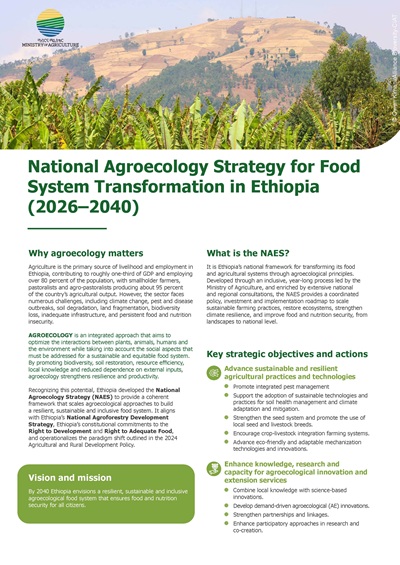
Agriculture is Ethiopia’s primary livelihood source, contributing one-third of GDP and employing over 80% of the population. Yet the sector faces climate change, pest outbreaks, soil degradation, biodiversity loss, and persistent food insecurity. Agroecology—an integrated approach optimizing interactions between plants, animals, humans, and the environment—offers a pathway to resilience and sustainability.
The National Agroecology Strategy (NAES) 2026–2040 provides a coherent framework to scale agroecological practices nationwide. Developed through inclusive consultations led by the Ministry of Agriculture, NAES aligns with Ethiopia’s National Agroforestry Development Strategy, constitutional commitments to the Right to Development and Right to Adequate Food, and the paradigm shift outlined in the 2024 Agricultural and Rural Development Policy.
Strategic objectives include advancing sustainable farming technologies, integrated pest management, soil health, climate adaptation, strengthening seed systems, promoting local breeds, crop-livestock integration, and eco-friendly mechanization. NAES positions agroecology as central to food system transformation, ecosystem restoration, and climate resilience.
Download :


This works is licensed under a Creative Commons Attribution 4.0 International License.
Authors
Ministry of Agriculture, Ethiopia,CIFOR-ICRAF
Publication year
2026


