Lessons on land tenure and forest landscape restoration in Africa
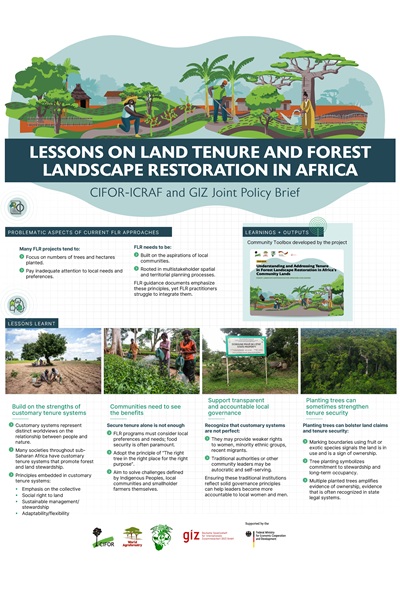
African land tenure systems are shaped by complex interactions between customary norms and state policies, with tenure security varying across contexts. While state-issued titles may offer protection in post-conflict settings, they can also exacerbate inequalities and disrupt local safety nets where customary systems remain strong. External pressures such as colonial legacies, private investment, and migration have historically undermined customary institutions. State recognition of customary tenure can improve negotiation power, but policies that claim ownership of untitled land or trees may discourage forest landscape restoration (FLR) efforts. Women and minorities face additional barriers, including limited land rights, weak legal enforcement, and underrepresentation in decision-making, all of which hinder equitable participation in FLR initiatives.
Download :


This works is licensed under a Creative Commons Attribution 4.0 International License.
Authors
Larson, A.M.,McLain, R.,Kassa, H.,Awono, A.,Ranjatson, P.
Publication year
2025