
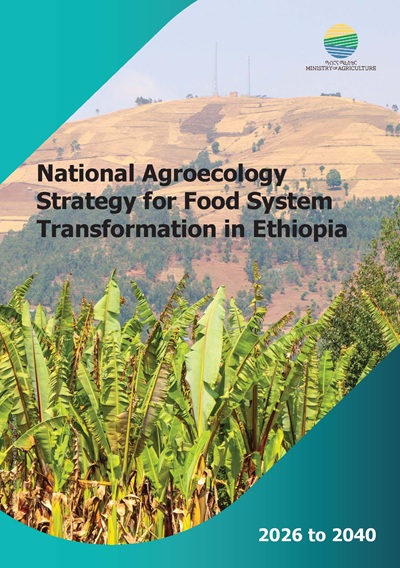
National Agroecology Strategy for Food System Transformation in Ethiopia, 2026 to 2040
Agriculture is the primary source of livelihood and employment in Ethiopia, as well as the country’s main generator of foreign currency. Smallholder farmers, pastoralists and agro-pastoralists are responsible for approximately 95 percent of the nation’s agricultural output. However, the sector faces numerous challenges, including climate change, limited access to modern technology, pests and disease outbreaks, soil degradation, land fragmentation, post-harvest loss, and inadequate institutional services and infrastructure.
Cognizant of Ethiopia’s dependence on agriculture and its vulnerability to food insecurity and climate-related risks, agroecology has emerged as a promising pathway to transform the country’s food system. It leverages ecological principles and local knowledge to promote sustainable farming, making it particularly relevant in contexts with diverse ecosystems and socioeconomic challenges. It has a multitude of benefits, including enhancing soil health and fertility, increasing biodiversity and ecosystem resilience, improving food security and nutrition, empowering smallholders and preserving traditional knowledge, minimizing reliance on external inputs, and improving rural livelihoods. Recognizing the potential of agroecology in transforming food systems, there is a growing interest among the government, NGOs and other development partners in Ethiopia. Despite its potential, the widespread adoption of agroecological practices was hindered by barriers such as limited political support, insufficient investment, low technological capacity, lack of community engagement, environmental pressures and gaps in legal and policy frameworks.
Download :


This works is licensed under a Creative Commons Attribution 4.0 International License.
Authors
Ministry of Agriculture of the Federal Democratic Republic of Ethiopia,Alliance of Bioversity International and CIAT,CIFOR-ICRAF
Publication year
2025
ISBN
978-9966-108-97-5

